
Mark Adkinson and Rosi Costoya bought a huge stone house in Galicia, the green north of Spain, that needed everything. It had holes in the roof that went through three floors and had never had running water. They rebuilt it themselves in 18 months for about €150,000 all in, and the bank now values it at half a million euros. Then they started Galician Country Homes, an award winning real estate agency in Galicia. This is the transcript of our 2022 podcast episode with them, edited for readability. It covers their renovation, the process of buying a home in Galicia, and why they love living there.
Watch the episode
Chapter 1: Restoring a 200 year old stone house
Chris: Hello and welcome back to another episode of the Cheap Property Spain video podcast. (Cheap Property Spain is SOBA's former name.)
A few weeks ago I sat down with Mark Adkinson and Rosa Costoya (Rosi), the founders of Galician Country Homes, a real estate agency located in Galicia in the northwest of Spain. I've been obsessed with their website ever since I found it about one year ago. They have some of the most amazing homes for sale at unbelievable prices.
For example, this one acre organic farm with a move-in ready cottage, a large stone house and a greenhouse for only 55,000 euros. Or if you're really feeling adventurous, how about this 14th century castle for only 225,000 euros. The list goes on and on.
Their agency is actually one of the best in Spain. They've won countless awards and been featured in magazines such as Forbes. Even more interesting than the homes is Mark and Rosi's own personal story. Neither of them ever set out to become real estate agents. Mark grew up in the UK and studied farming and agriculture. Rosi was born in France and spent the early part of her career as a veterinarian. But when the couple set out to find a family home, they ended up falling in love with an old stone house in a sleepy Galician village. The home had been vacant for decades and was in pretty awful shape. But Mark had a vision. He knew they could restore it and make a great home for their growing family.
Mark: Shall we say this? It had holes in the roof that went through three floors. And you could fall without touching the sides. In fact, my wife did fall through one. Luckily, I was below her. Typical case of this house is a ruin like the film, but worse.
Chris: So did you have a lot of experience prior to refinishing houses?
Mark: No, no, no. But I said we can do it. And I brought my wife to see the house. And I said, can you see we can restore these windows, these beams, these doors? And she said, "No, I can't see them."
I said, "What can you see?" She said, "Cobwebs and shit."
Rosi: This house has 200 years old, more or less.
Mark: It was Franco's chauffeur's house. It's where 12 of his Moroccan bodyguards were based with their black horses. Every time he came to Galicia, they got on the train with him. And they were with him when he was in Galicia. And when he wasn't here, they used to terrorize the area.
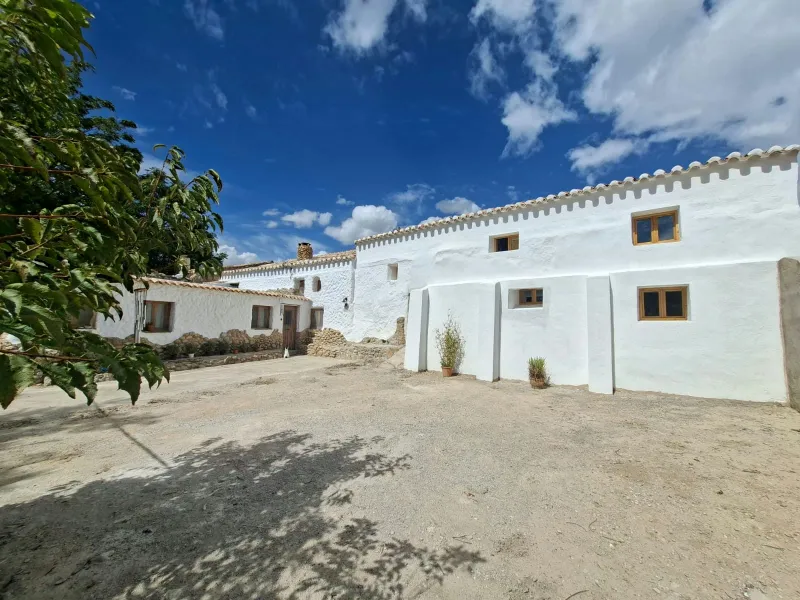
Photos of the restoration
Slate walls and a plan drawn from memory
Chris: That's amazing. What are these homes built of?
Mark: In our case, our house is built of slate with granite surrounds on the doors and on the windows. But a very, very hard slate, which is a local slate. And it's very difficult to chip with a big hammer. You've got to know how to do it. Luckily, all the walls were good on the house.
Chris: What is the size of this house?
Mark: About 650 square meters (7,000 square feet).
Chris: So you bought this huge house with several holes in it. What next?
Mark: The day I came into the house, I made a mental plan of how I would rebuild it. We only changed one thing, which was a staircase from one place to another. Apart from that, everything else came out of my mind.
Chris: Did you hire an architect?
Mark: I drew it up in my mind. I spread it on the floor, here, here, and here. Then we followed that plan.
Permits, water and what it cost
Chris: What was the first step?
Mark: We asked for approval from the local town council to put on a new roof. And then after that, we asked for an interior light works and interior permit.
They said, "What are you going to do?" I said put in a bathroom, electricity, and this house never had water. So I connected the water. We have a spring just in front of us.
We've done a bit more than that since. It's now worth half a million euros according to the bank.
Chris: What did you pay for the house originally, when it was, you know, with holes in the roof and everything?
Mark: I think it was 50,000 euros? No, I'm thinking of pesetas, 50,000 pesetas (the former currency in Spain). Our total expense would be somewhere about 150,000 euros all in.
Rosi: It is more expensive if you hire contractors to do the work.
Doing the work themselves
Chris: So you did all the work yourselves?
Mark: We did all the work ourselves except for one thing, which was putting the slate on the roof. It was March, it was frosty, and one man on the roof is not a good idea. We got some slaters to put the roof on. We prepared all the wood, got everything done, except for that. And that took them about four days to complete the roof.
Chris: I tried to tile a bathroom at one point and it took me hours of just researching how to do it. So I can't even imagine remodeling an entire house myself. That's an amazing undertaking.
Mark: Well, one thing I like to tell people: my wife was sweating outside pointing the stonework. She did all the pointing on the house. She chipped off all the plaster, she washed it all, and then she pointed it again. And I asked her, "What do you want for your birthday?" And she said, "What do you think? A concrete mixer!"
Rosi: It is my best friend.
Chris: How long did it take to finish the renovation and move in?
Mark: Let me just explain. Every day after work, after eight to 10 hours' work, I put in an extra six hours on the house. My wife couldn't do that during the week, because she was taking care of the kids. But on Saturdays and Sundays, she came and we put some boards over the holes in the floor. And we left the kids out to pasture in the house while we worked on it. It took 18 months.
Chris: Was it stressful on your family?
Mark: Well, put it this way. We did cry sometimes.
Chris: Of course. But you've made it through, and 20 years later, was it worth it?
Mark: Certainly, certainly.
Chapter 2: Building a business
Chris: Once they finished building their home, Mark's health started to decline and he was forced to find a new career. That's when he had the idea to become an estate agent.
Mark: Well, about two years afterwards, I had health problems with one of my hips and I couldn't handle the weight. So I couldn't work on farms. And the doctor said, hold on as long as you can without operating. And my wife said, "What are you going to do?" I said, "Well, let's just think about this."
I think we will sell houses, set up a website. I had never been on the Internet in my life. And she said, "Do you think you can make a living?" I said, "How many people have done up their own house completely in Galicia?" She said, "50, 100, 150. Not more." And I said, "And how many of those people speak six languages?" She said, "You're probably the only one." I said, "Fine, and if I'm not the only one, how many get on well with everybody?" She said, "You'll make a living."
And here we are 18 years later.
Templar houses and a bishop's summer home
Chris: So what are some of the most unique homes you've sold?
Mark: Well, the most expensive one was a summer home for the Bishop of Santiago. The home had 60 hectares of land and about eight houses with it, which were built by the Templars.
Chris: Wow, the Knights Templar?
Mark: Yes, they had the crosses on them on the inside, because at that time they were being hunted down. So they never put them on the outside of the houses. Also, we've sold stately homes that were built by Christopher Columbus's parents in 1400. We have just sold a horse training center to some people from Abu Dhabi. This was two weeks ago. And we more or less sell anything that's in Galicia, except for apartments and flats. We don't sell things within the cities really, at all. We focus on rustic homes, country homes, etc. We don't do any rentals either. We only do sales. When people come to us, the first thing we say is, "Tell us what your dreams are and we'll try to make them come true."
Chris: What's the best way for people to reach you?
Mark: Visit our website to view all the homes we have available: grupocountryhomes.com
(Editor's note, October 2026: the original address, galicianrustic.com/en/, now redirects to this site.)
Paying for a home: cash, mortgages and seller financing
Chris: How do clients typically pay for homes in Galicia? Do they pay in cash? Or do they obtain some sort of financing?
Mark: Normally, most of them pay in cash. You can get a mortgage here, but you have to justify where your money is coming from and that you can pay the mortgage. Or if you've got properties, you must bring the list of the properties you have, so the banks trust you.
Chris: Yeah, it can be difficult. I know quite a few people who make their income from retirement or passive income, or from a company in the United States or something, but the Spanish banks find it difficult to work with a foreign person with income in that way.
Mark: If you can justify your income with wage slips or pension slips, and apart from that, the houses or the properties you may have in another part of the world. As long as you can prove the wage that's coming in would pay for the mortgage, you should have no problem. We have agreements with banks here to help our clients out as well.
Chris: Okay. So it is possible, then, to obtain a mortgage in Spain based on foreign income.
Mark: Yes, as long as you can justify it. Apart from that, there are certain countries where the banks, as with most countries, want to know where the money is coming from, for example, Colombia, etc.
Chris: Is it possible for a buyer to obtain seller financing, where the seller of the home essentially finances the purchase for them?
Mark: Not really. There've been a couple of cases where they've allowed them to pay part of it a year later. But that's all, just a couple of cases.
Chris: Wow. So it's just really not done much in Spain?
Mark: No, not really, not really. Some people are a bit frightened of you paying one installment and then being a squatter, or whatever.
Chapter 3: What is the process of buying a house in Galicia?
(Editor's note, October 2026: the taxes, fees and incentives below are as Mark described them in April 2022. Rates change, so check the current figures with a lawyer or gestor before you buy.)
Mark walked us through the steps:
- Come and see the property.
- Open a bank account in Spain if you want to buy.
- Sign a holding contract. The money goes into the owner's bank account. If the owner goes back on the deal, he has to give you twice as much back as you put down. If you go back on it, you lose your deposit.
- Be careful. Some unscrupulous agents expect the money to be paid into their account, which is completely illegal, and refuse to give back the money if the sale doesn't go ahead.
- Complete at the notary. When you have transferred the money to a Spanish bank, we go to the notary and hand over a certified banker's cheque. The property has normally been bought and sold before and is registered, so there is no problem with the paperwork.
- Pay taxes and fees. Once you complete the purchase, you would have to pay 9% between taxes, notary fees and registration fees within 30 days. If you intend to live here permanently, the costs would be less (around 8%). The taxes are 6% if you don't intend to live in Spain and 5% if you do.
- Commission. The owner typically pays our commission.
Also, if people under 35 years old purchase a home in Galicia, they will not pay any taxes on the property, because they're trying to get young people of childbearing age to come into the area. This is because Galicia has been very deprived over the years. We've got the oldest population in Europe. We have 1,600 people over 100 years of age.
Chris: He's not joking. There are actually a ton of incentives from the local government for those who want to buy a property in Galicia. The largest ones are available if you move to a town with less than 10,000 people, which is like 90% of the towns in the area. So almost anyone who buys a home here qualifies for some kind of tax rebate.
Mark: You won't pay tax on the property when you buy it, and on the land neither, and I don't think you'd pay any tax from then on. But even tax on a house here in the countryside might be 40 euros a year.
Chapter 4: What is Galicia like?
Chris: Since Mark and Rosi have been living in Galicia for over 20 years, I took the opportunity to ask them what the area is like. It's known for being very different from the Spain most tourists see, far from Barcelona and the beaches of the Costa del Sol. Galicia has a spirit of its own.
It's located on the Bay of Biscay, just above Portugal, and its history is intertwined with both Spanish and, surprisingly, Celtic traditions. The area is covered in rivers, trees and, well, greenery. That's probably why they call it España Verde. Some of the most popular cities include Santiago de Compostela, Vigo, Pontevedra and A Coruña.
How would you describe Galicia to people who may have never been to it?
Mark: Should we put it this way: it's got a similar climate to the English Midlands, but about 10 degrees warmer on average. It rains as much as it would in the Midlands, but if not, you wouldn't have 300 million trees. You wouldn't have 10,000 kilometers of trout, salmon and sea trout rivers, and you wouldn't have the climate where anything you plant grows tremendously. You don't need much land here to produce all you need. You don't need much land at all.
According to The Times, we have some of the best beaches in the world. And apart from that, we've got beaches all the way around. Very similar to Cornwall, well, a lot warmer.
Chris: Mark, did you speak Spanish before you moved?
Mark: Before I came to Spain? Not a word. In six months, I could speak reasonable Spanish. And when I came to Galicia, after three years on the other side of Spain, my Spanish was pretty good. Now I think it's impeccable.
The locals speak Spanish and Gallego, our local language, which is similar to Portuguese. But everybody speaks Spanish. And if they notice you don't understand Gallego, immediately they'll swap into Spanish for you.
And the thing I would like to say, and this is important: the people here don't care where you come from. They don't care what color you are, which way your eyes look, up or down or whatever. They accept everybody naturally. We've never had anybody complain about being discriminated against. They might look at you for the first time and say, "Where are you from?" But the second time, they'll say, "Come on, I'll give you a beer."
Thinking about an old stone house of your own?
Mark and Rosi's house shows what a rural ruin in Spain can become with a clear plan, a lot of weekends and a concrete mixer. If you're looking for your own project, browse rural homes in Homes in Spain Spain, run the monthly numbers with our Buying costs cost of living calculator, and read more buying guides in Spain buying guide. If you're not an EU citizen, plan your viewing trips around the Schengen 90 day limit with 90/180.